


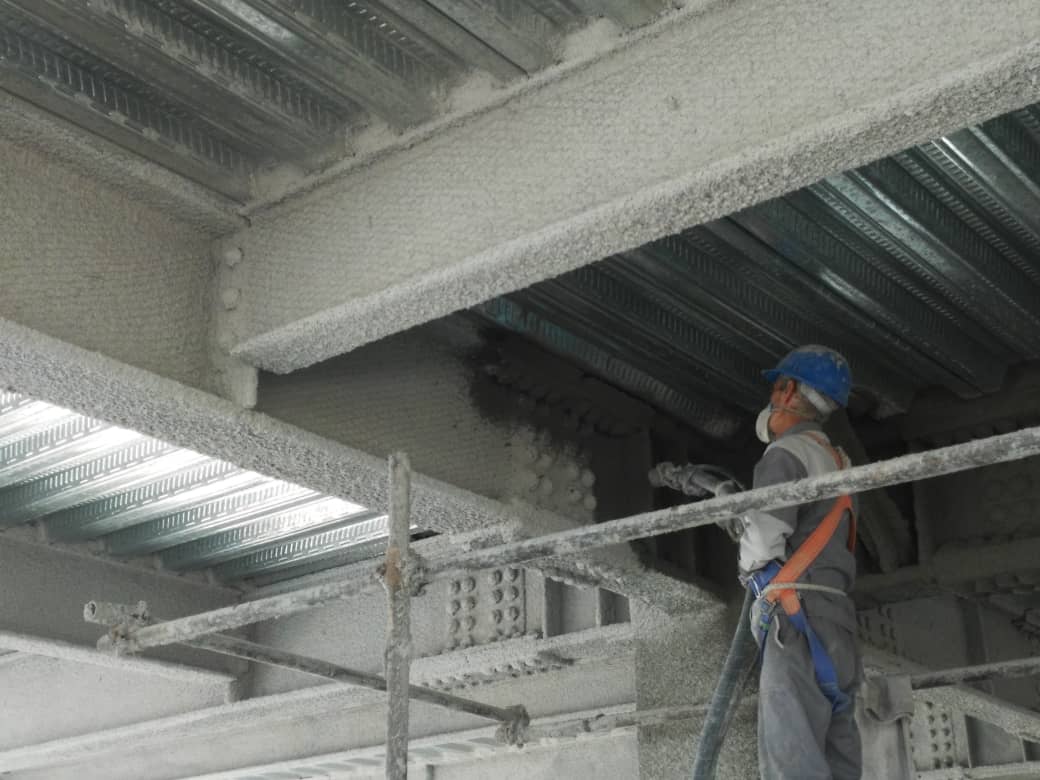
Fire-resistant coating, or fireproofing, is highly important for buildings in order to minimize potential human and financial losses by complying with safety regulations. Fireproof coating is a layer applied to structural elements used in different parts of a building, including the frame, beams, columns, etc. It increases the building’s resistance to fire and thermal stress and significantly reduces the spread rate of fire. As a result, temperature rise does not lead to the collapse of main structural components, and during an incident, the temperature of beams and columns does not reach the level (approximately 470–500°C) at which steel loses its strength, collapses, or the structural system is destroyed, leading to total failure.
In fact, by adding appropriate mortars based on the type of structure—including steel, concrete, and even wooden structures—the resistance and load-bearing capacity of buildings, frames, and columns can be increased during fire incidents until occupants can evacuate and rescue and firefighting teams arrive. This helps prevent structural collapse or loss of stability.
Skilled engineers fully coat structures according to their type using specially designed mortars with specific details, ensuring that during a fire, conditions remain safe enough to allow evacuation and rescue operations.
The taller a structure is and the greater the number of floors it has, the higher its exposure to fire risk. On the other hand, as buildings become taller, their resistance to fire generally decreases. Therefore, this is a highly important issue in construction and structural safety control.
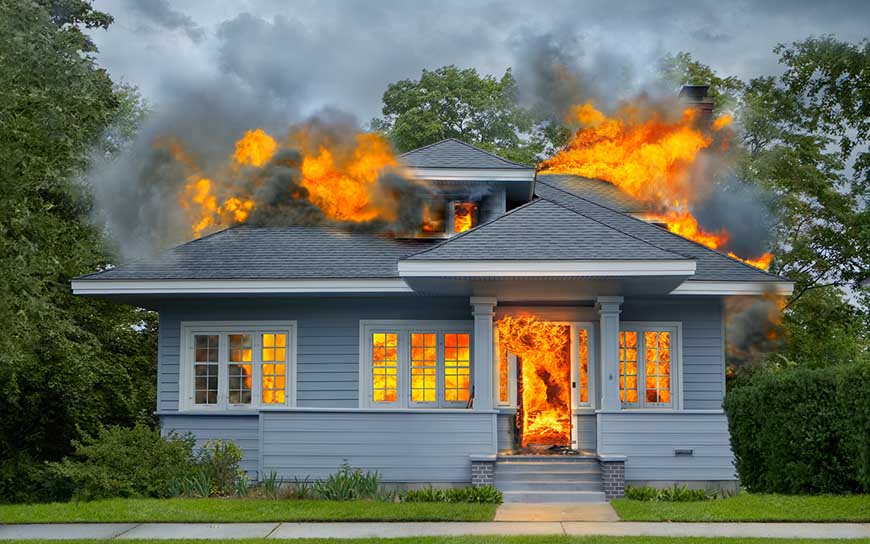
The duration of structural fire protection depends on several important factors, including the type of building structure, its function and geometry, the presence of flammable materials in buildings, types of possible fire scenarios, the distance of the structure from the fire station, the time of fire occurrence, and more.
The design and evaluation of fire-resistant coatings require a precise understanding of fire and its behavior on structures. Fireproof coatings (Fireproofing) are essential elements in controlling fire damage and reducing potential financial and human losses during fire incidents.
They are a fundamental requirement for modern large-scale structures such as schools, healthcare centers (including hospitals), educational institutions like universities, commercial and recreational malls, residential buildings, industrial facilities—especially in oil, gas, and energy sectors—as well as high-occupancy places such as museums.
Fireproof coatings can be applied not only to new structures but also to existing buildings. In case parts of the coating are damaged or removed, repair and restoration are also possible.
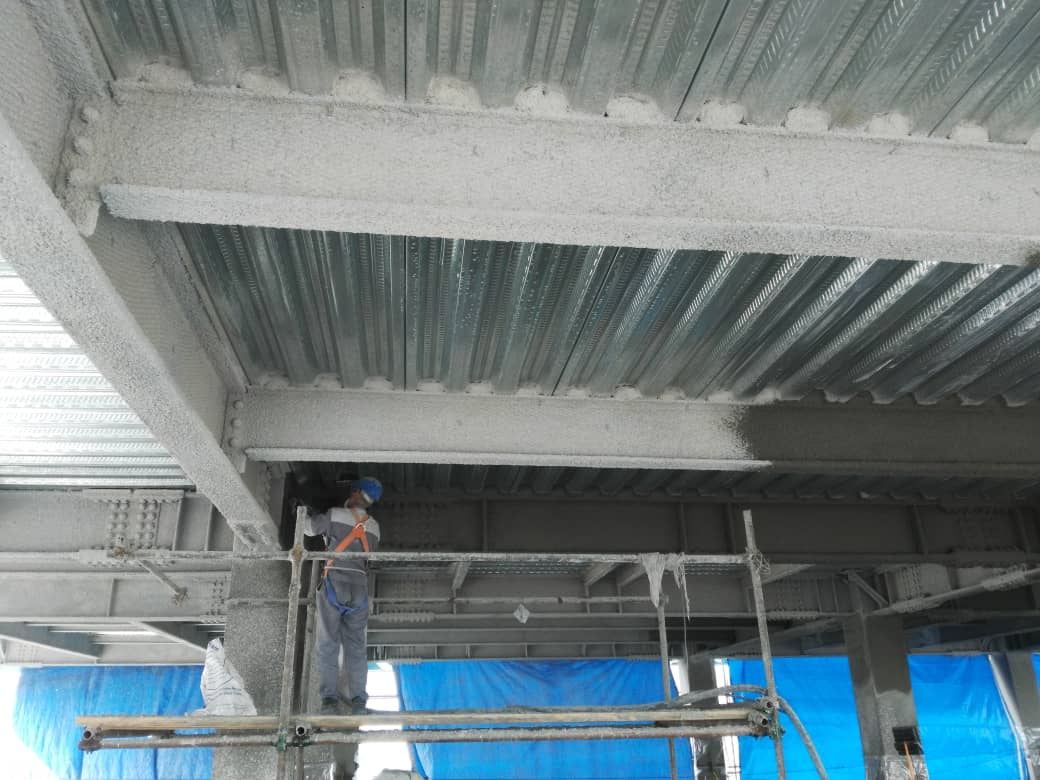
What is fireproof coating for steel structures?
Fire is considered an unpredictable event, and it is necessary to be prepared in order to reduce both human and financial losses. Fireproof coating for steel structures is one of the methods used to fireproof buildings and increase the structure’s resistance to fire.
Due to the type of materials used in these coatings, the structural frame can resist fire for a specified period of time. Fireproof coatings are used for both steel frames and concrete structures.
If this coating meets the required standards and is applied correctly, it can provide protection for up to three hours and withstand temperatures of around 1000°C, thereby protecting the structure.
Benefits of using fireproof (fire-resistant) coating
As the name of these coatings suggests, the first and most important benefit of using them is preventing the spread of fire within the structure. Due to this important function, a second advantage is also achieved, which is the reduction of damage and losses to the building during a fire.
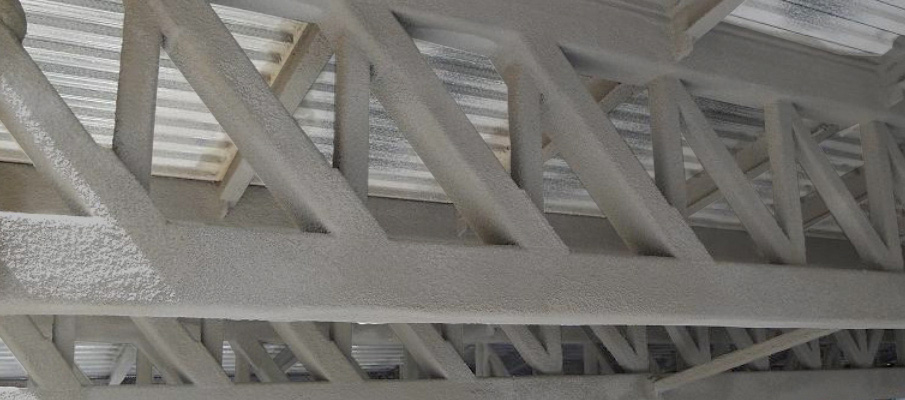
Due to these advantages in improving building safety, the use of fireproof coatings for steel structures has become very common nowadays and is considered one of the important standards in construction.
Types of fireproof coatings for steel structures
In general, two types of these coatings are commonly used:
- Fire-resistant paints
- Bulking coatings
The first type is similar to commercially available paints and is applied by spraying, with a specified thickness and layer. This paint acts as an insulating layer on steel beams and metal frames, helping to increase their resistance to fire.
The second type, which is intumescent and swelling, significantly expands when exposed to the first flames of a fire and turns into a solid, char-like layer. These materials form a strong barrier against the spread and development of fire for up to about two hours.
Fireproofing or fire-resistant coating has many advantages, and the most important ones are listed below.
Advantages of fireproofing
- It provides sufficient time for people and valuable belongings to be evacuated from fire-affected buildings.
- By significantly increasing the thermal stress resistance of steel and concrete structures, it delays the collapse of the building.
- It does not change the appearance of the structure and does not reduce the building’s aesthetic value.
- It does not emit toxic fumes after exposure to fire.
- From a hygienic perspective, it does not allow the growth of bacteria, fungi, etc., on the surface of the structure.
- It has the advantage of being easy to apply.
- It increases the quality and grade of construction materials.
- It can be implemented in any type of structure, whether new or existing.
- It is easily repairable.
- In addition to increasing the fire resistance threshold, they also act as sound insulators.
- It prevents corrosion and deterioration of steel structures.
Disadvantages of fireproofing or fire-resistant coatings:
- It requires specialists for coating design.
- It requires specialists for coating application.
- It increases the overall construction completion time.
However, despite the mentioned drawbacks, the protection and insulation of the structure are far more important.
Fireproofing of steel structures
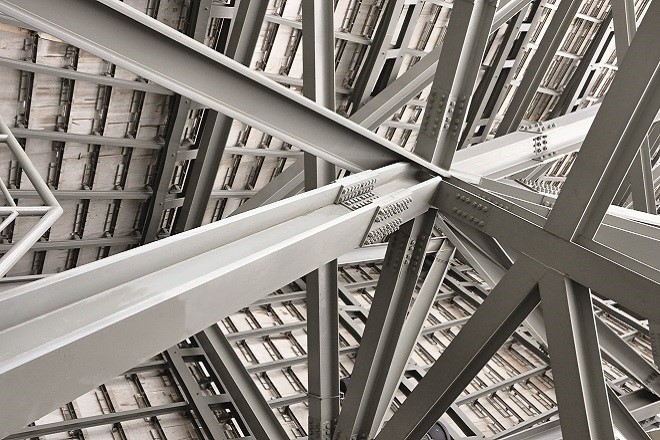
About half of the steel produced worldwide is used in the construction sector. Steel is classified as a non-combustible material, and steel structures typically melt at around 2500°F, while building fires usually reach temperatures in the range of 2000°F. Therefore, the likelihood of steel melting is very low; however, this does not mean that steel structures are safe in fire conditions.
Fireproof or fire-resistant coatings are mainly used in steel structures because metal structures show lower fire resistance compared to concrete structures.
Under standard conditions, a steel structure with fire-resistant coating should be able to withstand temperatures up to about 1200°C for approximately two hours. However, without fire protection, steel can lose nearly half of its strength in less than ten minutes at around 500°C, leading to buckling, bending, deformation, and ultimately structural collapse.
In fact, structural designers and supervisors must consider fireproofing as one of the most important components of passive protection systems in steel structures. Accordingly, main beams and columns are covered with fire-resistant coatings suitable for steel structures, and in special cases, floors, ceilings, and walls are also insulated.
In structures where the risk of ignition and fire is very high, such as power plants or refineries, the most important aspect of structural protection is providing a fire-resistant coating for steel structures.
The steel section factor, or Section Factor, which is obtained by dividing the exposed surface area to fire by the total cross-sectional area, has a significant impact on the thickness of the fireproof coating. The higher this factor is—meaning the greater the surface exposed to fire or the smaller the metal thickness—the greater the required coating thickness will be.
To determine the required thickness and perform the necessary calculations, engineers must obtain information from structural drawings, such as the type and thickness of steel deck roofs, the size and section of load-bearing beams, the dimensions of columns, and the required fire resistance time.
This level of coating must also be economically feasible in terms of cost, and ultimately, a coating will be accepted according to the relevant standards and regulations if the average applied thickness is not less than the originally designed coating thickness.
Fireproofing of columns
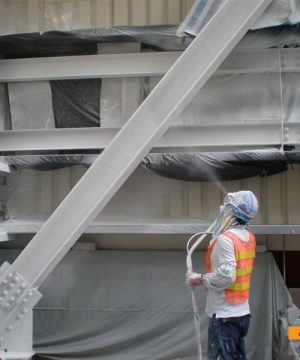
Columns in a structure, due to their critical role in supporting the building, are of greater importance in fireproofing systems. Because the bending or failure of even a single column can lead to the collapse of the entire structure.
Columns in buildings not only carry the load of their own floor but also bear the weight of all upper floors. Therefore, as we move toward the lower levels of a structure, the importance of columns increases, and consequently, fireproofing becomes especially essential for such structural elements.
Fireproof installation
To apply fire-resistant coating on beam and column surfaces, the first step is to clean and prepare the surfaces thoroughly, after which the covering process is carried out.
After the consultation process for selecting the best fireproofing system, suitable materials are chosen based on the criteria previously mentioned for the type of structure.
Fireproofing application is a professional process that requires skilled personnel in this field, and it is usually carried out by experienced contractors who employ specialized engineers and professional operators with years of experience.
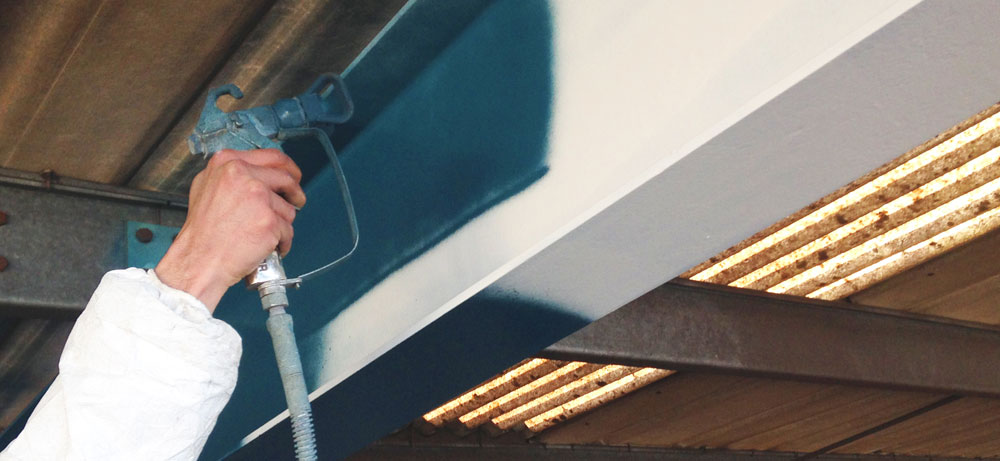
For fire-resistant coatings, paint-based systems are applied using brushes or spray equipment, whereas for mineral-based systems, machinery and mechanical tools are used.
The contractor applies the coating to the surfaces using electric spray guns and similar equipment. The coating material, together with compressed air stored in the gun tank, is sprayed onto beams and columns in the form of powder-like particles.
To achieve better adhesion of the fireproof layer to steel or concrete structures, a primer should be used as an adhesion promoter. This not only improves bonding strength but also helps protect the steel against corrosion.
For greater durability of fire-resistant coatings, a top coat can also be used. A top coat is a solution that helps the coating layer dry faster and prevents peeling or flaking of the protective layer. Finally, curing (Curing) is applied to prevent possible cracking.
During the application and covering of beams and columns with suitable protective materials, many important factors must be considered. One key point is that the structure must be coated in a way that, even under increasing temperature, the fire-resistant layer remains firmly attached to the steel structure and maintains proper adhesion.
Another very important point is ensuring a uniform thickness of the required fireproof coating on the structure, so that in a critical situation it can effectively act as a barrier and prevent heat from reaching the underlying surface.
The next consideration comes after the structure has been coated with fireproof materials. It should be noted that heavy cladding should not be installed over this coating, as it cannot تحمل heavy facade loads. On the other hand, facade materials cannot be applied directly onto fireproof paints, because direct installation of cladding on fire-resistant coatings may compromise their protective properties.
In general, there are three types of fireproofing that are used by designers and engineers.
Types of fireproofing
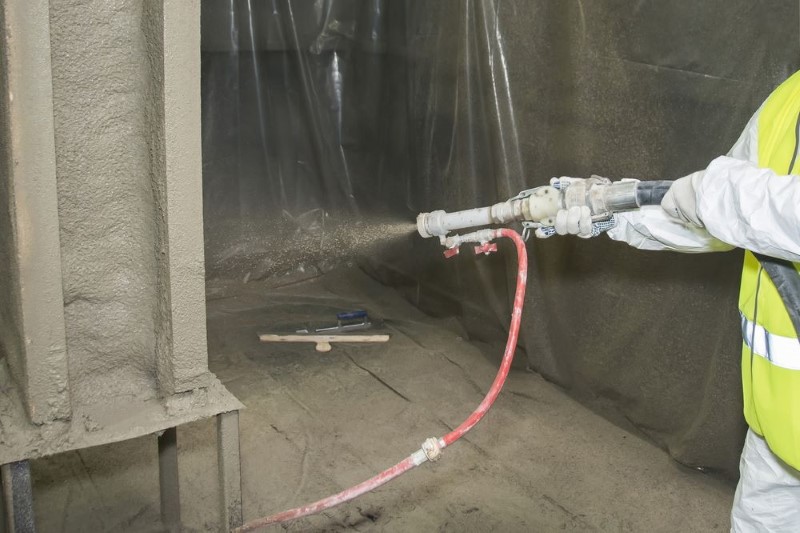
Fireproofing based on intumescent coatings
These coatings are intumescent or expanding fire-resistant paints. They are based on organic resins and have a very thin initial thickness at a micron scale. They help the structure gain higher resistance by expanding when exposed to fire.
Resin-based fireproofing systems, when exposed to fire, react at around 200°C like a thermal sensor, activating the fire-resistant coating. As they expand in volume, they swell over steel and concrete structures and turn into a solid, char-like layer. This expanded volume prevents fire from reaching the underlying layers.
Because these coatings are water-based, they do not emit toxic gases or vapors during a fire, making them safe. The resulting carbon layer can expand from 5 to 200 times its original volume, and due to the high porosity formed, it also exhibits strong water absorption capacity.
Fireproofing materials are generally composed of four main components:
Chloroprene-type resins, which are non-flammable and help create porosity in the coating by releasing non-flammable gases at elevated temperatures.
Silicate pigments, which help prevent the spread and propagation of fire.
Phosphoric acid, which creates an acidic environment after expansion and contributes to the formation of carbon char.
Ceramic or mineral fillers, which further strengthen and reinforce the structural coating.
Under normal conditions, fire-resistant coatings applied on beams and columns have a thickness of about 6 mm, and upon expansion they can reach approximately 2.5 cm, becoming significantly thicker. In this state, instead of a thin paint layer, millions of expanded cellular structures are formed with high resistance to heat, preventing fire and heat from penetrating the underlying layers of the coating. This helps prevent structural collapse and provides sufficient time for rescue and evacuation operations.
After expansion, due to the high porosity, the material also exhibits increased water absorption capacity, which can assist in fire suppression and structural protection.
In this condition, the fire resistance duration is typically between 1 to 2 hours, at temperatures around 1000°C, and its application requires greater skill compared to mineral-based materials.
This type of fire-resistant coating can be applied on both internal and external surfaces of steel and concrete structures, and it can also be implemented on wooden structures. Fireproof paint is applicable in various types of buildings.
It is suitable for structures with a high risk of fire, such as refineries, power plants, silos, and warehouses, as well as industrial facilities. It is also used in buildings that require a high level of safety, such as hospitals and schools. In addition, it is ideal for structures where architectural appearance is important and the building is exposed to public view, as this type of coating also has decorative applications.
These coatings, depending on the type and fire conditions as well as the applied thickness, can delay reaching critical and dangerous temperatures for the structure by 30 to 120 minutes.
The overall cost of this type of fireproofing is higher than cementitious and mineral-based systems, but it provides better insulation performance for all types of construction materials.
As a summary, the advantages of fire-resistant paint coatings can be listed as follows:
- This type of coating does not take up space and does not affect the building’s aesthetics or structural finesse, and it is applied on the structural frame in a thickness ranging from 0.5 to 5.5 millimeters.
- The paint coating is very lightweight.
- It activates at the appropriate temperature without the need for thermal sensors or detectors.
- It is easy to apply.
- The gases emitted from it do not contain toxic vapors.
- There is no need to smooth or level the structural surfaces after application, as it is naturally uniform and even.
- It is cost-effective both in terms of time and money.
- It is easily repairable and restorable.
The key applications of paint-based fireproofing systems are as follows:
Buildings that
- Where the façade and appearance are highly important.
- Have limited space.
- Have a high weight.
- Require high levels of hygiene and safety.
- Need to be fireproofed in a short time.
Equipment used in fireproofing.
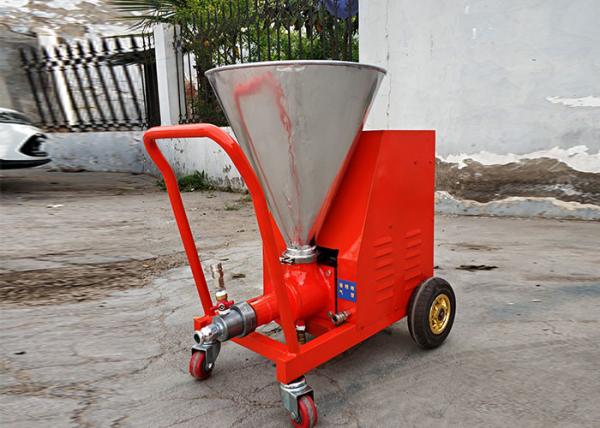
For fireproofing a structure, manpower alone is not sufficient, and a comprehensive set of machinery and hand tools is required, including mechanical equipment, electrical equipment, pneumatic machines, and hydraulic machinery. Hydraulic machines refer to equipment that uses fluid power for operation.
The fire-resistant coating materials are placed inside the tanks of these machines and are sprayed onto surfaces under high air pressure. These devices include wet-mix and dry-mix sprayers, plaster sprayers, cement sprayers, spiral (worm) mortar pumps, piston shotcrete pumps, and others, which come in various types and models.
Mortar-based or mineral-based fireproof coatings
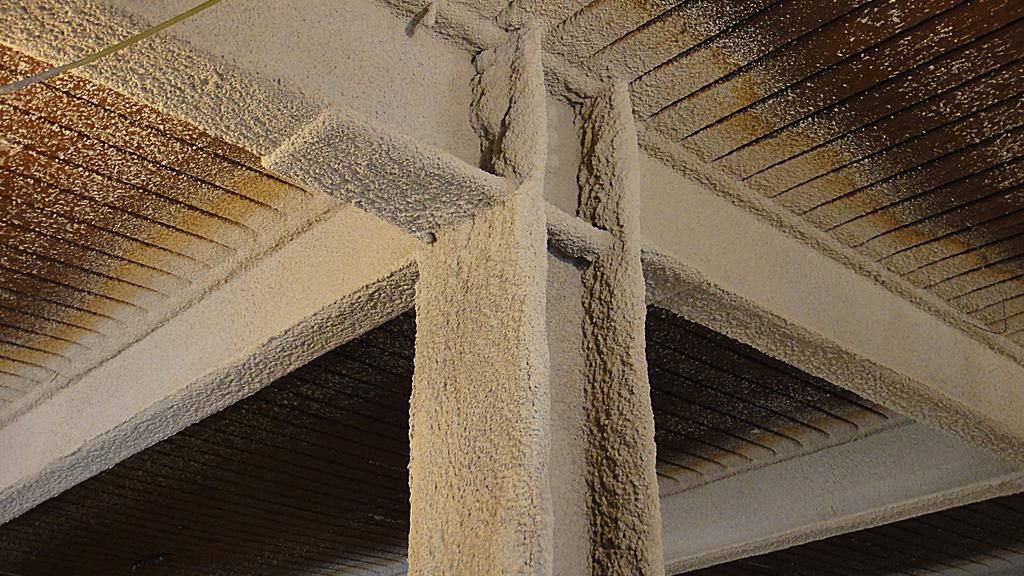
This type of fire-resistant coating consists of non-combustible mineral materials that are applied as mortar on the surfaces of beams and columns. Mineral-based spray-applied fireproof coatings can be either gypsum-based or cement-based.
Cement and gypsum act as binders that adhere the fireproof coating to beams and columns. Both materials are thermal insulators and poor heat conductors, and they are used as the base components in fireproofing systems.
In the gypsum-based system, the coating is lighter and more cost-effective. It can be used in prefabricated form and applied either by spraying or troweling. However, gypsum-based fireproofing is not suitable for humid environments.
In the cement-based system, the layer is thicker, heavier, and more durable, providing higher stability and longer service life. It is also suitable for moist environments. However, it is mainly recommended for stationary structures where no vibration or impact occurs.
Vermiculite, also known as lightweight industrial aggregates, is one of the components used in fireproof coatings. It is a mineral from the phyllosilicate group, extremely lightweight, with a layered, sheet-like structure.
Vermiculite provides high resistance to hydrocarbon and cellulose fires for both concrete and steel structures, withstanding temperatures of up to around 1200°C. It protects structures by offering very low thermal conductivity and can expand up to 30 times its original volume.
Mineral-based coating systems are water-based, have high paintability, and are applied onto steel structures using spray equipment. The thickness varies depending on the design requirements of the structure, but it is typically in the range of 15 to 30 mm.
Ultimately, by preventing the spread of heat along the steel structure, this system can protect it against fire for up to approximately three hours.
Vermiculite-based coatings are also highly resistant to blast shock, which is one of the key advantages of this type of fireproofing system. In addition to fire resistance, this mineral also acts as a thermal and acoustic insulator.
Another component used in this type of coating is perlite, a silica-based mineral that, like vermiculite, has high porosity, strong water absorption capacity, and expansion properties.
Dolomite and foaming agents are also among the other important constituents of this group of fireproofing systems.
In the structure of this type of coating, other components may also be included, such as latex resins, additives to enhance heat resistance, fire-spread inhibitors, and corrosion-reducing agents. Overall, all materials used must be free from any allergenic properties and toxic gas emissions.
Due to their high water absorption capacity after exposure to fire, these coatings can be used in sensitive environments such as hospital structures. They can also be applied on both internal and external surfaces of structural frames.
The thickness of mineral-based fireproof coatings, like intumescent paint systems, depends on the previously mentioned factors. For low thicknesses, mortar is applied directly by spraying. However, for higher thicknesses (more than 1 cm), special reinforcing meshes are used to strengthen the coating.
Despite sometimes reaching several centimeters in thickness, vermiculite-based coatings are more commonly used compared to paint-based or board-based insulation systems.
It should also be noted that after application, this type of fireproofing does not produce a smooth or uniform surface finish. Therefore, it is mainly used in structures where the risk of fire is high and aesthetic or architectural appearance is not a priority, such as refineries and power plants.
Advantages of mineral-based and cementitious fireproofing are as follows:
- High durability and resistance.
- Ease and simplicity of application.
- Cost-effective and economical.
- Resistant to moisture and weathering (cement-based).
- Lightweight coating (gypsum-based).
Fireproofing based on fire-resistant boards and panels:
These boards are made from a mixture of special resins, ceramic wool fibers, or similar structures and are produced in thicknesses ranging from 10 to 25 mm.
The use of fire-resistant boards is the fastest method of fire protection, but it is also the most expensive compared to the other two fireproofing methods mentioned. In addition, they cannot be applied on beams.
These fireproof panels are prefabricated and then transported to the structure for installation. In general, fire-resistant boards are more commonly used in situations where it is not possible to apply spray-based fireproofing systems within the structure. In such cases, board and panel systems become a very effective solution.
Conclusion
Safety and compliance with required standards are among the most important considerations during construction. Just as the strength of a structure against events such as floods and earthquakes is important, other unexpected hazards such as fire must also be taken into account, along with ways to increase a building’s resistance in such situations.
Fortunately, today fireproof coatings for steel structures are considered an effective method of fireproofing buildings and play a significant role in improving overall building safety.
To learn more about the best types of fireproofing machines or fire-resistant equipment, please visit Kalar’s website products.
FAQ
1. What is fireproofing or a fire-resistant coating?
Fire-resistant coating is a system used to protect buildings and various structures by increasing their resistance to fire and thermal stresses. Ultimately, it buys time for a fire-affected structure, providing one or several hours for occupants to evacuate the building and for rescue teams to extinguish the fire and prevent its spread.
Columns are among the most critical elements of structures, and if they are exposed to temperatures beyond their capacity, they may bend and deform. The failure of a single column can put the entire structure at risk of collapse. Therefore, insulating structures against fire—especially steel structures—is extremely important.
2.What are the advantages of fireproofing?
- It provides sufficient time for people and valuable belongings to be evacuated from fire-affected buildings.
- By significantly increasing the thermal stress resistance of steel and concrete structures, it delays the collapse of the building.
- It does not change the appearance of the structure and does not reduce the building’s aesthetic value.
- It does not emit toxic fumes after exposure to fire.
- From a hygienic perspective, it does not allow the growth of bacteria, fungi, etc., on the surface of the structure.
- It has the advantage of being easy to apply.
- It increases the quality and grade of construction materials.
- It can be implemented in any type of structure, whether new or existing.
- It is easily repairable.
- In addition to increasing the fire resistance threshold, they also act as sound insulators.
- It prevents corrosion and deterioration of steel structures.
3. How is fireproofing applied in structures?
Fire-resistant coating is applied by impregnating building structural frames—especially beams and columns—with materials and compounds that increase the structure’s load-bearing capacity and resistance to fire and thermal stress. It is typically added to surfaces using mechanical spray systems or by troweling.
These coatings are applied in a way that forms a protective layer on steel or concrete elements, helping to delay heat transfer and prevent structural failure during fire conditions.
4. How many types of fireproofing are used in structures?
In general, three types of fireproof coatings are applied in structures, and the appropriate type is selected based on factors such as the type and geometry of the structure, its function, its distance from emergency and rescue services, the amount of flammable materials present, and so on. These three types include:
- Intumescent (expanding) paint-based fireproofing.
- Mineral-based and cementitious fireproofing (mortar-based fireproofing).
- Fireproofing based on fire-resistant boards and panels.
5. Can fireproofing methods be chosen based on personal preference?
Here’s the English translation of your explanation:
**No. Fireproofing is a completely specialized process. Individuals without expertise cannot, under any circumstances, apply fire protection coatings to a structure based on their personal taste. The type of fireproofing must be determined through consultation with specialists in this field and by examining the structure from its drawings.**
6. What are the cheapest and most expensive types of firerproof?
Here is the English translation of your sentence:
**”Although fireproof coatings cannot be selected based on their price, and the criteria for choosing their type are other factors, resistant boards and panels have the highest price, while fireproof coatings based on mineral materials and mortar have relatively the lowest and most stable price.”**


